
Family-owned · Atlanta Local
Epoxy Coating Wood Floor and Concrete
We prep, prime, and coat concrete floors that hold up to real daily use.
Free estimate
Tell us what you need
Three fields. It reaches a person here, not a call centre.
Epoxy Coating on Concrete Floors, Done Once
Abner Flooring and Remodeling installs epoxy floor coatings on garage slabs, basement floors, patios, and utility spaces throughout the Greater Atlanta metro. If you've been searching for epoxy coating for a wood floor or a concrete surface, let's be direct: epoxy adheres to properly prepared concrete, not to raw wood flooring. What we do is coat and seal concrete slabs so they're hard, chemical-resistant, and look sharp for years. Most peeling epoxy jobs fail for one reason: bad surface prep. We grind the slab before a drop of epoxy goes down, and that step is what separates a floor that holds from one you're ripping up in three years. Call (404) 706-8999 any day of the week for a free estimate.
A standard garage floor epoxy project runs from surface grinding and cleaning, through a primer coat, to the broadcast color chips, to a clear topcoat that locks everything in. What drives cost is primarily square footage, the condition of the existing slab (cracks, spalling, or prior coatings all add prep time), and the finish system you choose. A single-coat paint-and-chip setup is priced very differently from a full multi-layer polyaspartic or 100-percent-solids epoxy system. We'll tell you which one makes sense for your space and what it will take to do it right. Every job is different -- contact Abner Flooring and Remodeling for an accurate estimate.
Why Most Epoxy Floors Fail Early
It's almost never the coating. It's always the prep underneath it.
What We Install
Epoxy Systems We Apply
Not every slab needs the same coating. Here's what we work with.
100% Solids Epoxy
The thickest, hardest epoxy available. No water, no solvents -- just pure resin that cures to a surface you can drive on. Best for garage floors that take vehicle traffic and heavy tool use daily.
Polyaspartic Topcoat
A UV-stable finish that doesn't yellow in sunlight. We use it as a final coat over epoxy base layers on floors that see direct sun -- patios, sun-facing garages, and outdoor utility slabs.
Flake and Chip Broadcast
Vinyl color chips broadcast into a wet base coat, then sealed under a clear topcoat. Adds texture (which helps with slip resistance), hides imperfections in the slab, and gives the floor real visual depth.
Solid Color Epoxy
A clean, single-color finish for shops, basements, and utility rooms where you want a sharp floor without the decorative chip pattern. Easier to keep clean and looks professional in a working space.
Metallic Epoxy
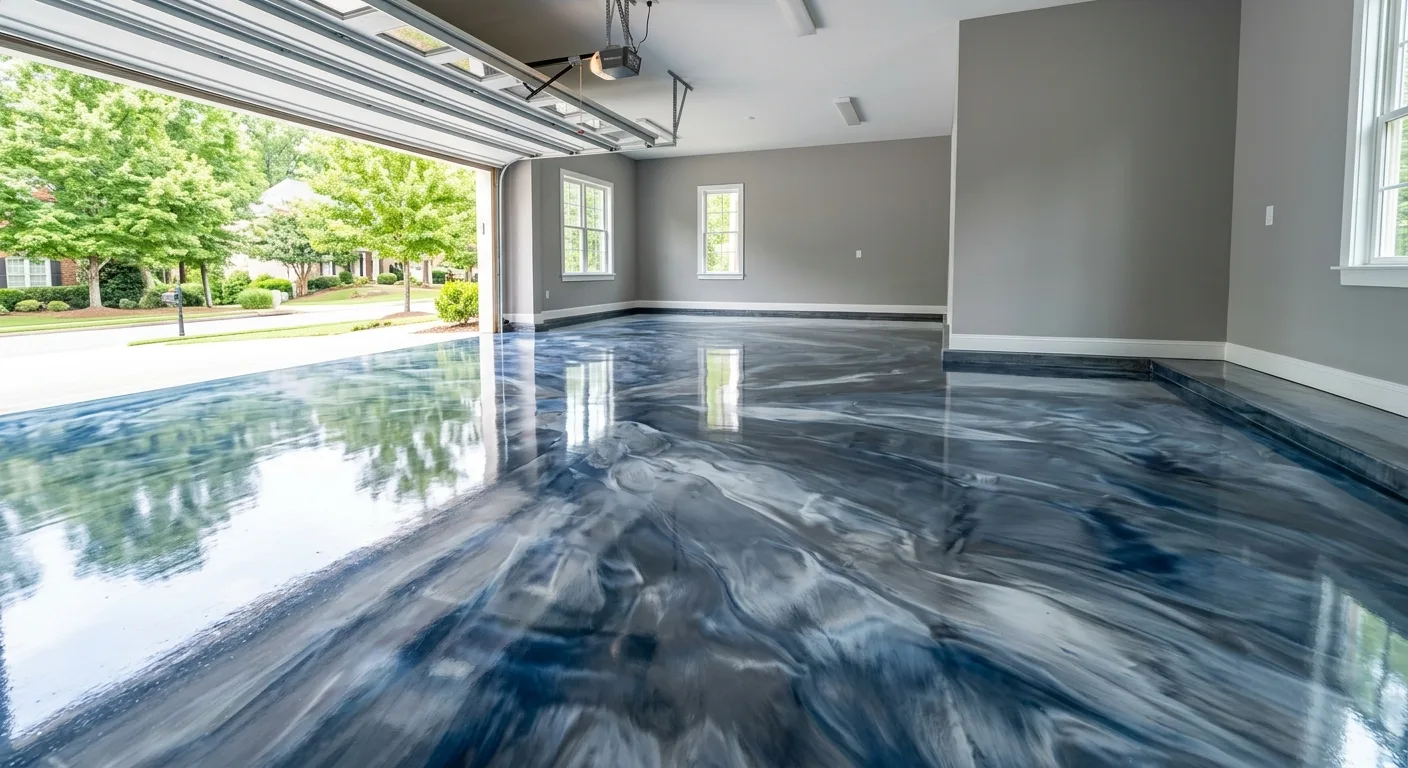
A specialty finish with a poured, reflective look. More involved to install correctly, but the result is unlike anything else underfoot. Used in showrooms, high-end garages, and finished basement spaces.
Our Process
How We Install an Epoxy Floor Coating
- 01
Surface Preparation
We grind the concrete with a diamond grinder to open the pores, remove any prior coatings, and profile the surface so the epoxy bonds mechanically. Cracks and spalls get filled and patched before anything else goes down.
- 02
Primer and Base Coat
A penetrating primer goes down first to seal the slab and block moisture vapor. Then the base coat -- the colored epoxy layer -- is applied at the correct wet-film thickness and broadcast with chips if you've chosen that finish.
- 03
Topcoat and Cure
A polyurethane or polyaspartic topcoat seals and protects everything underneath. We stay off the floor for the full cure window. Rushing this step is how you get a soft surface that scratches on day one.
Good to Know
Facts Worth Knowing Before You Coat
- 01
Concrete age matters
New concrete needs 28 days to fully cure before epoxy goes down. Coating it too early traps moisture and causes adhesion failure. If your slab is brand new, we'll tell you to wait.
- 02
Existing coatings must come off
If your floor has old paint, sealers, or a failed prior epoxy, we grind it off completely. Coating over a contaminated surface is the single most common reason epoxy peels prematurely.
- 03
Temperature and humidity affect the install
Epoxy cures through a chemical reaction sensitive to ambient temperature and relative humidity. We check conditions before we start. An install done in the wrong environment will not cure correctly.
- 04
Cured epoxy is extremely durable
A properly installed 100% solids epoxy floor resists oil, hot tire pickup, chemicals, and abrasion. It won't get soft in summer heat the way cheaper coatings do, and a topcoat protects the color for years.
Epoxy Works on More Than Garages
Common Questions About Epoxy Floor Coating
Can epoxy be applied directly over wood floors or subfloor?
How long does epoxy floor coating last on a garage slab?
Why is my existing garage floor epoxy peeling?
How long do I have to stay off the floor after epoxy is applied?
What's the difference between epoxy and a garage floor paint from a hardware store?
Can a concrete epoxy floor be installed on a patio or outdoor slab?
One Crew for the Floor and Everything Around It
Most flooring contractors coat the floor and leave. We handle what surrounds it.
- Available 7 days a week
- Call or text any day -- we don't go dark on weekends when most homeowners actually have time to deal with a project.
- Real surface prep on every job
- We grind before we coat. No shortcuts, no rolling epoxy onto a dusty slab and hoping it sticks.
- Full-scope capability
- If the project involves [concrete installation](/concrete-epoxy-floor-installation/), [flooring](/flooring-installation/), drywall, or painting, one call handles all of it through Abner Flooring and Remodeling.
- Free estimates, no pressure
- We'll look at the slab, tell you what it needs, and give you a number. You decide from there.